
Olamana puts a lot of time and energy into her designs. To get a perfect fit, our clothing is tested on different body types and we pay attention to the smallest details. It doesn’t matter to us whether you have an athletic build or a slightly fuller build. As long as your clothes fit well, you will feel confident and can brave any wave or mountain. That’s why size does matter!
We make certain clothes specifically for the male or female body, but for example our hoodies and surf jackets are unisex. We’ve heard from people who buy a surf hoodie from a competitor that they wear their harness over the hoodie because otherwise the fit is too tight. Our surf hoodies and jackets are specially made to wear your harness underneath and they have been tested for this. Of course, despite extensive testing, it can always happen that the specific harness you use is slightly larger. But in most cases we have figured it out for you!
Some people order duplicate products with different sizes and return one item. This is no problem. However, we try to propagate that people make conscious choices and rather choose their size right right away. That is why we have prepared this page for you to let you know how you can determine your perfect size.
If you don’t have a measuring tape, order it here.
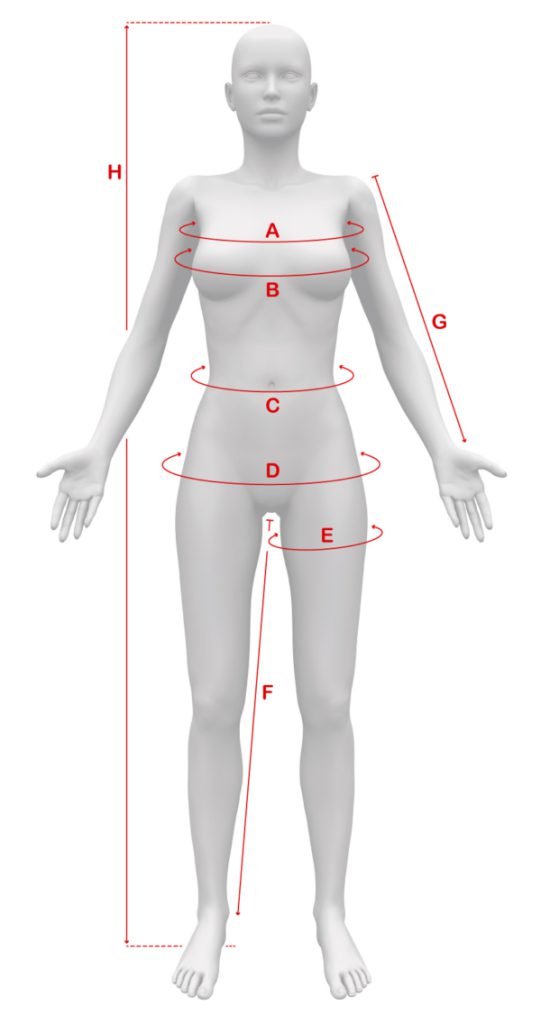
A size chart is shown for all our products on our website. This indicates which dimensions fit our sizes. Measure according to the image and instructions below and you’re good to go!
NOTE: Our neoprene surf hoodies and jackets are made to wear a harness and possibly an impact vest underneath. To determine the correct sizes, measure your sizes without these accessories. So always measure your measurements naked or in your underwear.
Take a chest measurement at the widest part of your chest. Place the tape measure in the center of your chest at the widest part, which is usually right above your nipples. Wrap it around your back, going under your armpits and making sure the tape measure stays horizontal and doesn’t twist.
Find your natural waist measurement. Your natural waist is where your waist is smallest but not always! Usually this is above your belly button and right below your rib cage. Go ahead and take this measurement even if you wear your pants in a slightly different place. Hold the end in front and wrap the rest of the tape measure around the back to take the measurement. Keep the tape measure a little loose by placing a finger between it and your waist.
During kitesurfing, the tight harness usually makes you slightly thinner at the waist. You also often see that the harness creeps up slightly. However, feel free to take the widest part of your waist. This way you can be sure that your neoprene hoodie or wetsuit fits well over your gear!
For pants only: If you usually wear low-rise pants, you can also take a measurement where your pants normally fall.
Measure your hips at the widest point of your hips. Stand with your legs about 6 inches (15 cm) apart. Wrap the tape measure around the place where your hips are the widest. Women tend to have wider hips than men. We take this into account when determining our sizes. The widest part of the hips is different on everyone, so it may take a couple of tries to figure out the correct placement for the measuring tape.
The width of the thigh is not always used. When you buy swimming trunks or other swimwear and waterwear from Olamana, we want you to buy a well-fitting product. That is why we find these measurements very important. It is better to take a larger size than a size that is too small or close-fitting.
Measure the circumference of the leg at the widest point of the thigh.
Put on a pair of shoes and measure your inseam measurement. You measure from your inside crotch down to where you want your pants to fall. Usually this is around the ankles.
If you need to do it yourself, try stepping on one end of the measuring tape and pulling it up to your crotch.
Another option is to take a pair of pants that fits your length well and measure the inseam on them instead.
Clothing doesn’t often use sleeve measurements, but it can be helpful to have the information if you’re shopping online. Place the end of the tape measure at the tip of your shoulder and measure down to your wrist. Measure to where you want the sleeve to fall, usually 1 to 2 cm further than the thinnest part of the wrist.
Of course, every body is different and not everyone has the same body proportions. However, it does give an indication of whether the garment will fit as designed. The length we use in our size charts is the length of the total body. This is measured from the ground to the highest point of the head (the crown).
Usually this is also the length indicated on your ID card or passport.
The shoulder measurement is not always used and usually fits like a charm when the other measurements work for you. Some people have very muscled shoulders, for them it could be useful to measure their shoulder measurements. Place one end of the measuring tape on the tip of one shoulder and draw it across your back. Find the measurement at the tip of the other shoulder, making sure the tape measure is flat across your back first and keep your shoulders straight.
| Cookie | Duration | Description |
|---|---|---|
| cookielawinfo-checkbox-analytics | 11 months | This cookie is set by GDPR Cookie Consent plugin. The cookie is used to store the user consent for the cookies in the category "Analytics". |
| cookielawinfo-checkbox-functional | 11 months | The cookie is set by GDPR cookie consent to record the user consent for the cookies in the category "Functional". |
| cookielawinfo-checkbox-necessary | 11 months | This cookie is set by GDPR Cookie Consent plugin. The cookies is used to store the user consent for the cookies in the category "Necessary". |
| cookielawinfo-checkbox-others | 11 months | This cookie is set by GDPR Cookie Consent plugin. The cookie is used to store the user consent for the cookies in the category "Other. |
| cookielawinfo-checkbox-performance | 11 months | This cookie is set by GDPR Cookie Consent plugin. The cookie is used to store the user consent for the cookies in the category "Performance". |
| viewed_cookie_policy | 11 months | The cookie is set by the GDPR Cookie Consent plugin and is used to store whether or not user has consented to the use of cookies. It does not store any personal data. |